The pipeline
One pass, from ambient audio to labelled EEG
Eventag detects each sound as it happens, marks it in the EEG signal itself, classifies it, and describes it. Every neural response ends up sitting against a labelled cause.
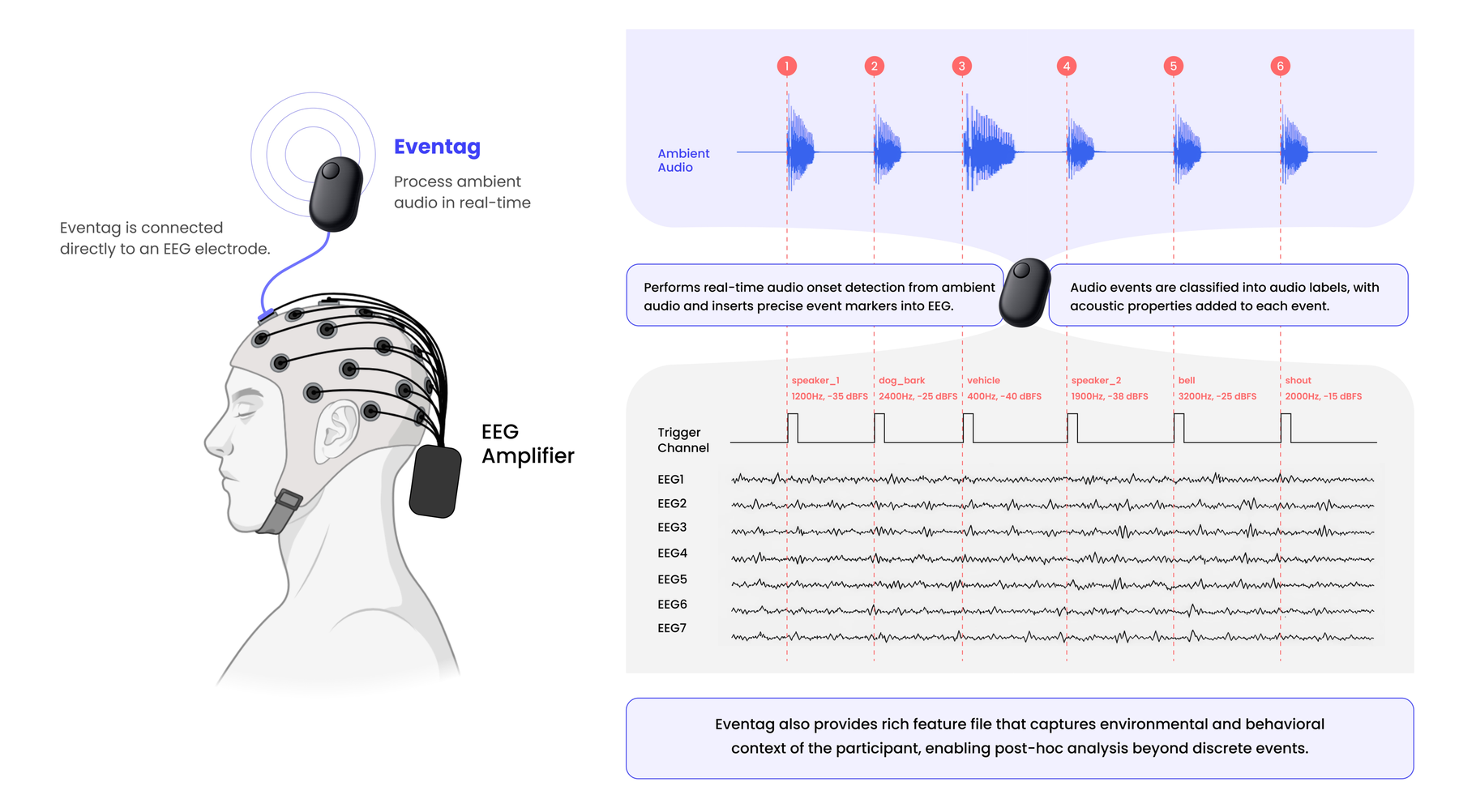
Eventag connects to a single EEG electrode, listens to the environment, and writes labelled, precisely timed event markers straight into your recording. Here is the full path, step by step.
Eventag connects directly to one EEG electrode and processes ambient audio on the device in real time. Your cap, amplifier, and analysis pipeline stay exactly as they are.
Eventag detects each sound as it happens, marks it in the EEG signal itself, classifies it, and describes it. Every neural response ends up sitting against a labelled cause.
Eventag continuously processes ambient audio on the device. Nothing is streamed off and no raw audio is stored. It keeps only what it needs to detect and describe an event.
The instant a sound begins, Eventag detects the onset and injects an event marker electrically, directly at the EEG electrode. Because the trigger enters the signal itself, it lands on a dedicated trigger channel with hardware-level, millisecond timing.
Each detected event is classified into a human-readable label, tagged with the model’s confidence, and stamped with the exact time it occurred in the recording.
Every marker is time-locked to the raw EEG. Alongside the discrete events, Eventag produces a rich feature file describing the environmental and behavioral context, so you can run post-hoc analysis that goes beyond single events.
Most real-world setups sync events after the fact, through software or streaming protocols like LSL. Over long, naturalistic recordings, those clocks drift, and the alignment you need for event-related analysis slips.
Eventag injects the trigger electrically, at the electrode. It becomes part of the EEG recording the moment it is created, so timing is hardware-level and does not depend on software clocks. That also makes it amplifier-agnostic: if your system records EEG, it can record an Eventag marker.
By the time a recording reaches your analysis pipeline, the context already sits inside it. Each event carries a label, the exact time it occurred, and the model’s confidence.
| Marker | Label | Time | Confidence |
|---|---|---|---|
| 1 | speaker_1 | 00:12.480 | 0.98 |
| 2 | dog_bark | 00:27.905 | 0.93 |
| 3 | vehicle | 00:41.210 | 0.88 |
| 4 | speaker_2 | 01:03.660 | 0.97 |
| 5 | bell | 01:18.045 | 0.91 |
| 6 | shout | 01:31.775 | 0.85 |
Markers time-locked to your raw EEG, ready to epoch.
Each event named, not left as an anonymous spike.
The exact time each event occurred, and how sure the model is.
Environmental and behavioral context for post-hoc analysis.
Eventag is a working prototype, and we are developing it together with labs running mobile and naturalistic EEG. If that is you, we would like to hear from you.